Just as a painter layers colors for depth, a chef builds flavors through precise technique. This blueberry yogurt smoothie recipe transcends the typical blender drink by applying professional culinary principles to achieve a velvety emulsion, balanced acidity, and vibrant color that holds. Journey beyond basic blending to master temperature control, ingredient sequencing, and textural refinement for a consistently exceptional result.
Why This Recipe Works
- Cold-chain integrity preserves berry pectin structure, preventing separation and yielding a thicker, more stable emulsion.
- Layering ingredients by density ensures even blade engagement, eliminating unprocessed chunks and achieving a homogeneous consistency.
- Acidic yogurt and sweet blueberries create a balanced pH profile that enhances flavor perception without added sugars.
- Precision blending times prevent overheating, which can degrade delicate anthocyanins and cause undesirable oxidation.
- Strategic liquid ratios produce a pourable yet spoonable viscosity ideal for both immediate consumption and brief chilled holding.
Ingredients
- 2 cups frozen wild blueberries (preferably individually quick-frozen to maintain cell structure)
- 1 ½ cups plain whole-milk Greek yogurt (strained for optimal thickness and protein content)
- ¾ cup unsweetened almond milk (chilled to 40°F for thermal management)
- 1 tablespoon raw honey (preferably local and unfiltered for nuanced floral notes)
- ½ teaspoon pure vanilla extract (alcohol-based for maximum flavor dispersion)
- ⅛ teaspoon fine sea salt (to enhance sweetness perception and balance acidity)
- Optional: 1 teaspoon freshly squeezed lemon juice (to brighten flavor if berries are overly sweet)
Equipment Needed
- High-speed blender (minimum 1,000 watts for proper shearing action)
- Digital kitchen scale (for precision measurement by weight)
- Instant-read thermometer (to monitor liquid temperature during blending)
- Rubber spatula (for efficient container scraping)
- Chilled serving glasses (pre-chilled to 35°F for optimal presentation)
Instructions
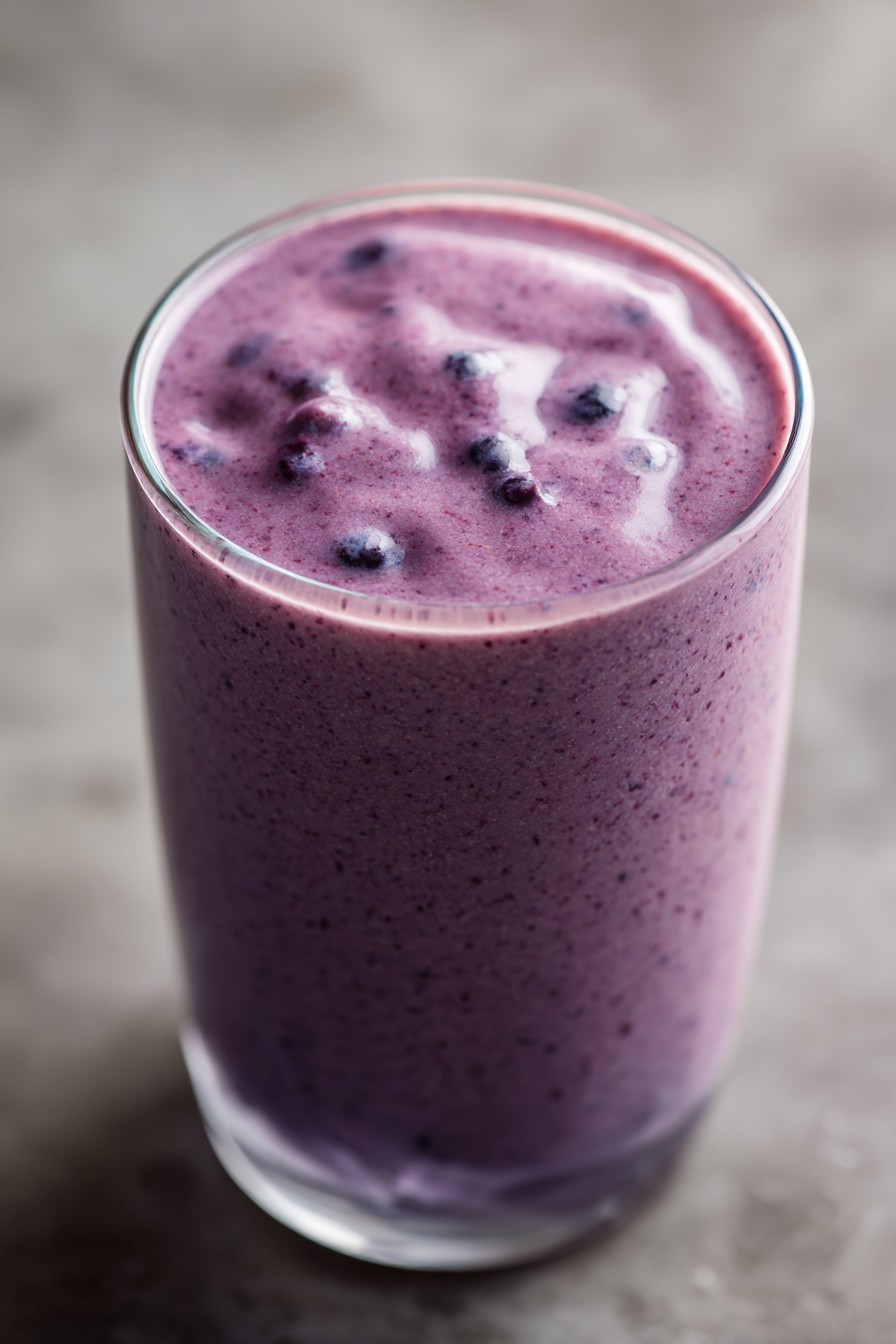
Step 1: Prepare and Sequence Ingredients
Begin by verifying all components are at their ideal temperatures: frozen blueberries should be solid at 0°F or below, almond milk chilled to 40°F, and yogurt refrigerated at 38°F. Using a digital scale, measure 10 ounces of frozen blueberries, ensuring uniform berry size for consistent processing. Portion 12 ounces of Greek yogurt, noting that its thickness will dictate final smoothie viscosity. Measure 6 fluid ounces of almond milk by volume, then check its temperature with an instant-read thermometer—if above 45°F, quick-chill in the freezer for 5 minutes. This thermal preparation prevents the blender motor from overheating and ensures the emulsion sets rapidly. Pro tip: Weighing ingredients rather than using volume measurements guarantees recipe consistency across batches, as berry density and yogurt thickness can vary significantly by brand and packing method.
Step 2: Establish the Liquid Base
Pour the chilled almond milk into the blender pitcher first, followed immediately by the Greek yogurt. This sequencing allows the thinner liquid to lubricate the blade assembly before introducing thicker components, reducing motor strain. Add the honey, vanilla extract, and sea salt directly into the liquid layer, where they’ll dissolve completely rather than sticking to the pitcher walls. If using lemon juice, incorporate it now to distribute acidity evenly throughout the base. Pulse the blender three times at low speed (setting 2 on a 10-speed model) for 2 seconds each, just enough to initiate hydration of the yogurt proteins without incorporating air. The mixture should appear slightly frothy at the edges but remain predominantly liquid. This foundational step creates a homogeneous medium that will evenly suspend the berry solids during high-speed blending.
Step 3: Incorporate Frozen Components
With the blender running on low speed (setting 3), gradually add the frozen blueberries through the feed tube over 15 seconds. This controlled introduction prevents blade stalling and ensures each berry makes immediate contact with the liquid base. Once all berries are added, increase speed to medium (setting 5) and blend for 45 seconds, using the tamper if available to push any stubborn berries toward the blades. Observe the mixture’s color transition from marbled purple to uniform violet—this visual cue indicates proper berry breakdown. The temperature should now register between 28-32°F on an instant-read thermometer inserted through the feed tube. Pro tip: Adding frozen ingredients while the blender is running creates a vortex that draws solids downward naturally, reducing the need for stopping and stirring mid-process.
Step 4: Achieve Final Emulsion
Increase blender speed to high (setting 8) and process for exactly 60 seconds. During this phase, monitor the sound profile: initial crushing noises should transition to a consistent high-pitched hum as the emulsion stabilizes. Watch for the mixture climbing the pitcher walls—if it rises more than one-third up the container, reduce speed slightly to maintain proper vortex formation. At the 45-second mark, check consistency by briefly stopping the blender and dipping a spoon; the smoothie should coat the back of the spoon evenly without immediate dripping. Complete the final 15 seconds of blending to achieve a velvety texture with no visible berry skins or seeds. The final temperature should not exceed 38°F to preserve the bright, fresh flavor profile.
Step 5: Portion and Serve Immediately
Working quickly to maintain temperature, pour the smoothie into pre-chilled glasses, filling each to within ½ inch of the rim to minimize surface oxidation. Use a rubber spatula to scrape the pitcher thoroughly, as the thickest portion often adheres to the sides and contains the most developed emulsion. Serve immediately while the smoothie maintains its optimal 34-36°F serving temperature. Observe the surface sheen: a slight gloss indicates proper fat dispersion from the yogurt, while tiny bubbles around the edges suggest ideal aeration. For presentation, garnish with three fresh blueberries placed deliberately off-center, and if desired, a light drizzle of honey in a zigzag pattern. Pro tip: Pouring in a continuous circular motion from a height of 6 inches creates a professional layered appearance in the glass, with slightly frothy top and dense bottom.
Tips and Tricks
For advanced texture control, consider these professional techniques. First, if your blender struggles with frozen fruit, pre-crush berries by placing them in a sealed bag and applying gentle pressure with a rolling pin—this creates fracture points for easier blending while maintaining frozen integrity. Second, for ultra-smooth results, strain the finished smoothie through a fine-mesh chinois to remove any remaining seed particles, though this will slightly reduce fiber content. Third, to enhance flavor development, macerate fresh blueberries with honey and lemon juice for 10 minutes before freezing them specifically for this recipe; this draws out natural juices that integrate more completely. Fourth, if preparing multiple batches, chill your blender pitcher between uses by filling it with ice water for 5 minutes to prevent temperature creep. Finally, for restaurant-style presentation, use a blowtorch to lightly caramelize a sprinkle of turbinado sugar on the rim of each glass before pouring.
Recipe Variations
- Protein-Enhanced Version: Replace ½ cup yogurt with 1 scoop vanilla whey protein isolate and increase almond milk to 1 cup; add ¼ teaspoon xanthan gum for stabilization.
- Tropical Twist: Substitute 1 cup frozen blueberries with ½ cup frozen mango and ½ cup frozen pineapple; use coconut yogurt instead of Greek yogurt.
- Green Power Adaptation: Add 1 cup fresh baby spinach during Step 2; increase honey to 1½ tablespoons to balance vegetal notes.
- Dairy-Free Alternative: Use coconut yogurt and replace honey with maple syrup; add ½ tablespoon chia seeds soaked in almond milk for 10 minutes to mimic yogurt thickness.
- Dessert Presentation: Layer smoothie with crumbled graham crackers and whipped cream in a parfait glass; finish with grated dark chocolate.
Frequently Asked Questions
Q: Can I use fresh blueberries instead of frozen?
A: Fresh berries will produce a thinner consistency and warmer temperature. If substituting, reduce almond milk to ½ cup and add 1 cup ice cubes during Step 3. The texture will be slightly less creamy due to reduced pectin release from freezing.
Q: Why does my smoothie separate after sitting?
A: Separation indicates insufficient emulsion time or incorrect temperature ratios. Ensure berries are fully frozen (0°F or below) and blend at high speed for the full 60 seconds. Adding ¼ teaspoon guar gum during Step 2 can improve stability for extended holding.
Q: Can I prepare this smoothie in advance?
A: For optimal texture, blend immediately before serving. If necessary, store in an airtight container for up to 2 hours, then re-blend for 15 seconds before serving. Overnight storage is not recommended as pectin continues to break down.
Q: What if I don’t have a high-speed blender?
A: Standard blenders require adaptation: thaw berries for 5 minutes, blend liquids and yogurt first for 60 seconds, then add berries in two batches with 30-second blends between. Expect slightly grainier texture but similar flavor.
Q: How can I reduce the tartness without adding sugar?
A: Select ripe, sweet blueberries and omit lemon juice. Alternatively, replace ½ cup blueberries with frozen banana slices, which provide natural sweetness and creaminess without refined sugars.
Summary
This technique-driven blueberry yogurt smoothie achieves professional quality through temperature management, precise sequencing, and controlled emulsion times. Mastering these culinary principles yields consistently perfect texture and balanced flavor in every batch.
Blueberry Yogurt Smoothie
2
servings8
minutes2
minutesIngredients
Instructions
- 1 Prepare all ingredients: ensure blueberries are frozen solid, almond milk chilled to 40°F, and yogurt refrigerated at 38°F.
- 2 Pour almond milk into blender, followed by yogurt, honey, vanilla, salt, and optional lemon juice. Pulse three times at low speed for 2 seconds each.
- 3 With blender running on low, gradually add frozen blueberries over 15 seconds. Increase to medium speed and blend for 45 seconds until uniform violet color appears.
- 4 Increase to high speed and blend for exactly 60 seconds until velvety smooth with no visible solids. Final temperature should not exceed 38°F.
- 5 Immediately pour into chilled glasses, garnish with fresh blueberries if desired, and serve.