Meticulously crafted bread pudding transcends its humble origins when executed with precision. Mastering this dessert requires attention to custard consistency, bread saturation, and baking technique to achieve a textural contrast between a crisp top and a tender, creamy interior. The accompanying vanilla sauce, a crème anglaise derivative, provides a luxurious counterpoint with its velvety richness.
Why This Recipe Works
- Utilizing day-old, sturdy bread like brioche or challah ensures optimal custard absorption without structural collapse during baking.
- A precise custard base, tempered to 165°F, guarantees a silky, set texture without curdling, creating the pudding’s foundational creaminess.
- The dual-temperature baking method—starting at 375°F for crust formation and reducing to 325°F—achieves a golden-brown, caramelized top while gently cooking the center.
- The vanilla sauce employs a classic crème anglaise technique, where egg yolks are carefully tempered with hot cream to create a stable, spoon-coating emulsion.
Ingredients
- For the Bread Pudding: 1 pound day-old brioche or challah, cut into 1-inch cubes (about 10 cups loosely packed); 4 large whole eggs; 3 large egg yolks; 2 cups heavy cream (36-40% milkfat); 2 cups whole milk; 1 cup granulated sugar; 1/4 cup light brown sugar, packed; 2 teaspoons pure vanilla extract; 1 teaspoon ground cinnamon; 1/2 teaspoon fine sea salt; 1/4 teaspoon freshly grated nutmeg; 4 tablespoons unsalted butter, melted and slightly cooled.
- For the Vanilla Sauce: 1 cup heavy cream; 1 cup whole milk; 1/2 cup granulated sugar; 4 large egg yolks; 1 whole vanilla bean, split and seeds scraped (or 2 teaspoons pure vanilla extract); 1/8 teaspoon fine sea salt.
Equipment Needed
- 9×13-inch baking dish (preferably ceramic or glass)
- Large mixing bowl
- Medium saucepan (2-quart capacity)
- Whisk
- Fine-mesh strainer
- Instant-read thermometer
- Rubber spatula
- Measuring cups and spoons
Instructions
Step 1: Prepare the Bread and Custard Base
Begin by arranging the cubed brioche in a single layer on a baking sheet. Allow it to air-dry at room temperature for one hour to slightly stale the exterior, which will enhance its ability to absorb the custard without becoming mushy. Meanwhile, in a large mixing bowl, vigorously whisk the whole eggs and additional yolks until they are pale yellow and slightly thickened, approximately two minutes. In a separate medium saucepan, combine the heavy cream, whole milk, granulated sugar, brown sugar, vanilla extract, cinnamon, salt, and nutmeg. Heat this mixture over medium heat, stirring frequently with a whisk, until it reaches 165°F on an instant-read thermometer and the sugars are fully dissolved. This temperature is critical for pasteurization and sugar integration without scalding the dairy. Proceed to temper the eggs by slowly ladling about one cup of the hot cream mixture into the eggs while whisking constantly to prevent curdling. Then, gradually whisk the tempered egg mixture back into the saucepan. Cook over low heat, stirring constantly with a rubber spatula, until the custard thickens slightly and coats the back of a spoon, reaching 175°F. Immediately remove from heat and stir in the melted butter until fully emulsified. Tip: For a deeper flavor profile, consider toasting the bread cubes at 300°F for 10-15 minutes until lightly golden instead of air-drying.
Step 2: Assemble and Soak the Pudding
Transfer the slightly dried bread cubes into the prepared 9×13-inch baking dish, distributing them evenly. Pour the warm custard mixture evenly over the bread, ensuring all cubes are submerged. Using clean hands or a spatula, gently press down on the bread to encourage saturation, but avoid breaking the cubes. Cover the dish tightly with plastic wrap, pressing it directly onto the surface of the custard to prevent a skin from forming. Refrigerate the assembly for a minimum of four hours, or preferably overnight. This extended soaking period is non-negotiable; it allows the bread to fully hydrate and the custard to penetrate each cube’s matrix, resulting in a uniformly tender texture without dry pockets. The custard will be fully absorbed, leaving no visible liquid pooling. Before baking, allow the dish to sit at room temperature for 30 minutes to ensure even cooking from the center outward.
Step 3: Bake to Perfection
Preheat your oven to 375°F with a rack positioned in the center. Remove the plastic wrap from the baking dish. Place the dish on a rimmed baking sheet to catch any potential overflow. Bake at 375°F for 25 minutes. This initial high heat promotes rapid oven spring and initiates the Maillard reaction, creating a beautifully caramelized and crisp top crust. Then, without opening the oven door, reduce the temperature to 325°F and continue baking for an additional 35-40 minutes. The pudding is done when the center reaches an internal temperature of 185°F on an instant-read thermometer, the top is a deep golden brown, and it springs back lightly when pressed in the center. If the top begins to brown too quickly, tent it loosely with aluminum foil. Tip: For a textural contrast, sprinkle the top with a tablespoon of turbinado sugar before the initial high-heat bake.
Step 4: Prepare the Vanilla Sauce (Crème Anglaise)
While the pudding bakes or rests, prepare the sauce. In a medium saucepan, combine the heavy cream, whole milk, half of the granulated sugar, the scraped seeds from the vanilla bean (and the pod), and salt. Heat over medium heat until the mixture just begins to simmer around the edges, approximately 180°F. In a separate bowl, whisk the egg yolks with the remaining sugar until the mixture is pale, thick, and forms a ribbon when the whisk is lifted, about three minutes. Temper the yolks by slowly pouring about one-third of the hot cream mixture into them while whisking vigorously. Then, pour the tempered yolk mixture back into the saucepan with the remaining cream. Cook over low heat, stirring constantly with a wooden spoon or heatproof spatula, until the sauce thickens enough to coat the back of the spoon and reaches 170-175°F. Do not allow it to boil. Immediately strain the sauce through a fine-mesh sieve into a clean bowl to remove the vanilla pod and any cooked egg bits. Stir occasionally as it cools to room temperature to prevent a skin from forming. The sauce will continue to thicken as it cools. Tip: For an ultra-smooth sauce, use an immersion blender for 15 seconds after straining to ensure perfect emulsion.
Step 5: Rest, Serve, and Plate
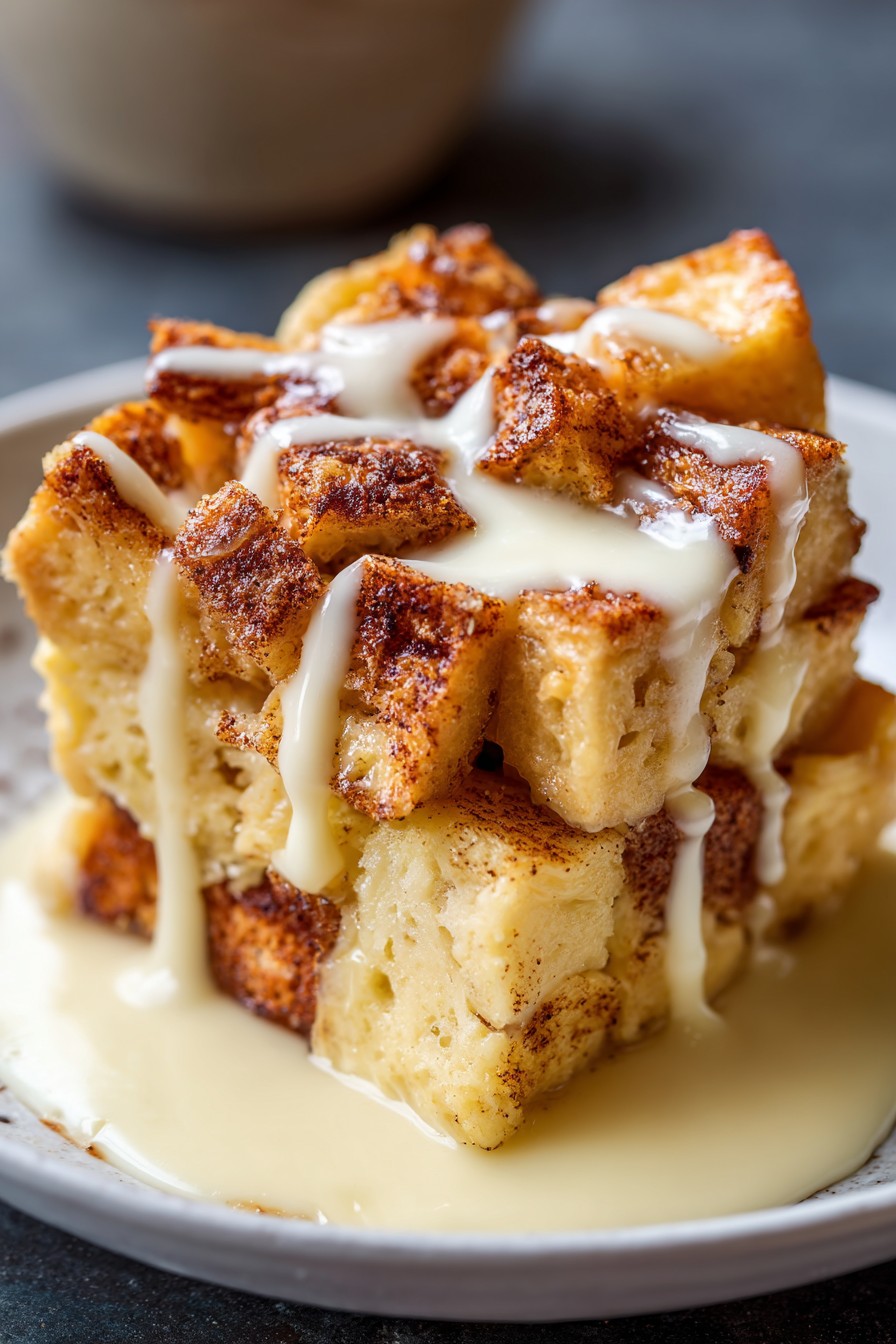
Once the bread pudding is removed from the oven, transfer it to a wire cooling rack. It is imperative to let it rest for a minimum of 45 minutes before serving. This resting period allows the custard to fully set, the internal steam to redistribute, and the structure to firm up, ensuring clean slices. To serve, portion the pudding using a sharp knife dipped in hot water. Plate individual servings warm or at room temperature. Generously ladle the cooled vanilla sauce over each portion. The final presentation should highlight the contrast between the crisp, caramelized top of the pudding and the glossy, fluid sauce. For garnish, a light dusting of powdered sugar or a few fresh berries can add visual appeal without overpowering the primary flavors.
Tips and Tricks
For a professional finish, consider these advanced techniques. To infuse the custard with deeper flavor, steep the warm cream mixture with the cinnamon, nutmeg, and a strip of orange or lemon zest for 30 minutes off heat before straining and proceeding with the tempering step. If your bread pudding develops a soufflé-like dome during baking, immediately after removing it from the oven, gently press the center down with a flat spatula to create an even surface for saucing. When making the vanilla sauce, if you suspect the emulsion is breaking or becoming grainy, immediately remove it from heat and blend vigorously with an immersion blender or transfer to a standard blender for 10 seconds to re-emulsify. For make-ahead convenience, both the assembled, unbaked pudding and the finished vanilla sauce can be refrigerated separately for up to 24 hours; gently reheat the sauce in a double boiler before serving.
Recipe Variations
- Chocolate-Chunk Bread Pudding: Fold 8 ounces of roughly chopped bittersweet chocolate (60-70% cacao) into the custard-soaked bread before baking. For the sauce, replace the vanilla bean with 2 ounces of finely chopped chocolate, whisking it into the hot crème anglaise until melted and smooth.
- Bourbon-Pecan Bread Pudding: Add 1/4 cup of high-quality bourbon to the custard base. Toast 1 cup of pecan halves at 350°F for 8 minutes, then chop and fold into the bread mixture before soaking. Incorporate 1 tablespoon of bourbon into the finished vanilla sauce.
- Apple-Cinnamon Bread Pudding: Sauté 2 cups of peeled, diced Granny Smith apples in 2 tablespoons of butter with 2 tablespoons of brown sugar and 1/2 teaspoon of cinnamon until just tender. Layer the apples between the bread cubes during assembly. Enhance the custard with an additional 1/2 teaspoon of cinnamon.
- Savory Breakfast Bread Pudding: Omit all sugars, cinnamon, and nutmeg. To the custard, add 1 teaspoon of dry mustard, 1/2 teaspoon of smoked paprika, 1 cup of shredded sharp cheddar, and 6 ounces of cooked, crumbled breakfast sausage. Bake as directed and serve with a creamy peppercorn gravy instead of vanilla sauce.
Frequently Asked Questions
Q: Can I use fresh bread instead of day-old bread?
A: Using fresh bread is not recommended as it lacks the structural integrity to absorb the custard properly, often resulting in a mushy, dense final product. The slight staling process (air-drying or light toasting) is crucial for creating pockets that hold the custard and provide the desired texture.
Q: My custard seems thin after soaking. Did I do something wrong?
A: A fully absorbed custard with no visible liquid is the goal. If liquid remains, the bread may have been too fresh or the soaking time was insufficient. Ensure a minimum 4-hour soak, preferably overnight. The custard will set further during baking.
Q: Can I make this recipe gluten-free or dairy-free?
A: For a gluten-free version, use a sturdy gluten-free bread like a dense brioche or baguette substitute. For dairy-free, replace all dairy with full-fat, unsweetened coconut milk and use a plant-based butter. Note that flavor and texture profiles will shift accordingly.
Q: How should I store and reheat leftovers?
A: Store cooled bread pudding and sauce separately in airtight containers in the refrigerator for up to 3 days. Reheat individual portions of pudding, covered, in a 325°F oven for 10-15 minutes or until warmed through. Gently reheat the sauce in a double boiler or microwave in short bursts, stirring frequently.
Q: Why is tempering the eggs so important?
A: Tempering gradually raises the temperature of the eggs by adding hot liquid, preventing them from scrambling or curdling when introduced to the main heat source. This technique is essential for creating a smooth, silky custard in both the pudding base and the vanilla sauce.
Summary
This bread pudding achieves excellence through technique: proper bread selection, precise custard tempering, controlled baking, and a classic crème anglaise. The result is a dessert of contrasting textures and harmonious, rich flavors.
Bread Pudding with Vanilla Sauce
12
servings30
minutes65
minutesIngredients
Instructions
- 1 Air-dry bread cubes 1 hour. Whisk eggs. Heat cream, milk, sugars, vanilla, spices, salt to 165°F. Temper eggs with hot cream, return to pan, cook to 175°F. Stir in butter.
- 2 Place bread in 9x13" dish. Pour custard over, press to submerge. Cover, refrigerate 4+ hours. Bring to room temp 30 mins before baking.
- 3 Preheat oven 375°F. Bake pudding 25 mins. Reduce to 325°F, bake 35-40 mins until center is 185°F and top is golden. Cool 45+ mins.
- 4 For sauce: Heat cream, milk, half the sugar, vanilla, salt to 180°F. Whisk yolks and remaining sugar until ribbon forms. Temper yolks, return to pan, cook to 170-175°F. Strain, cool.
- 5 Slice pudding, serve with vanilla sauce.