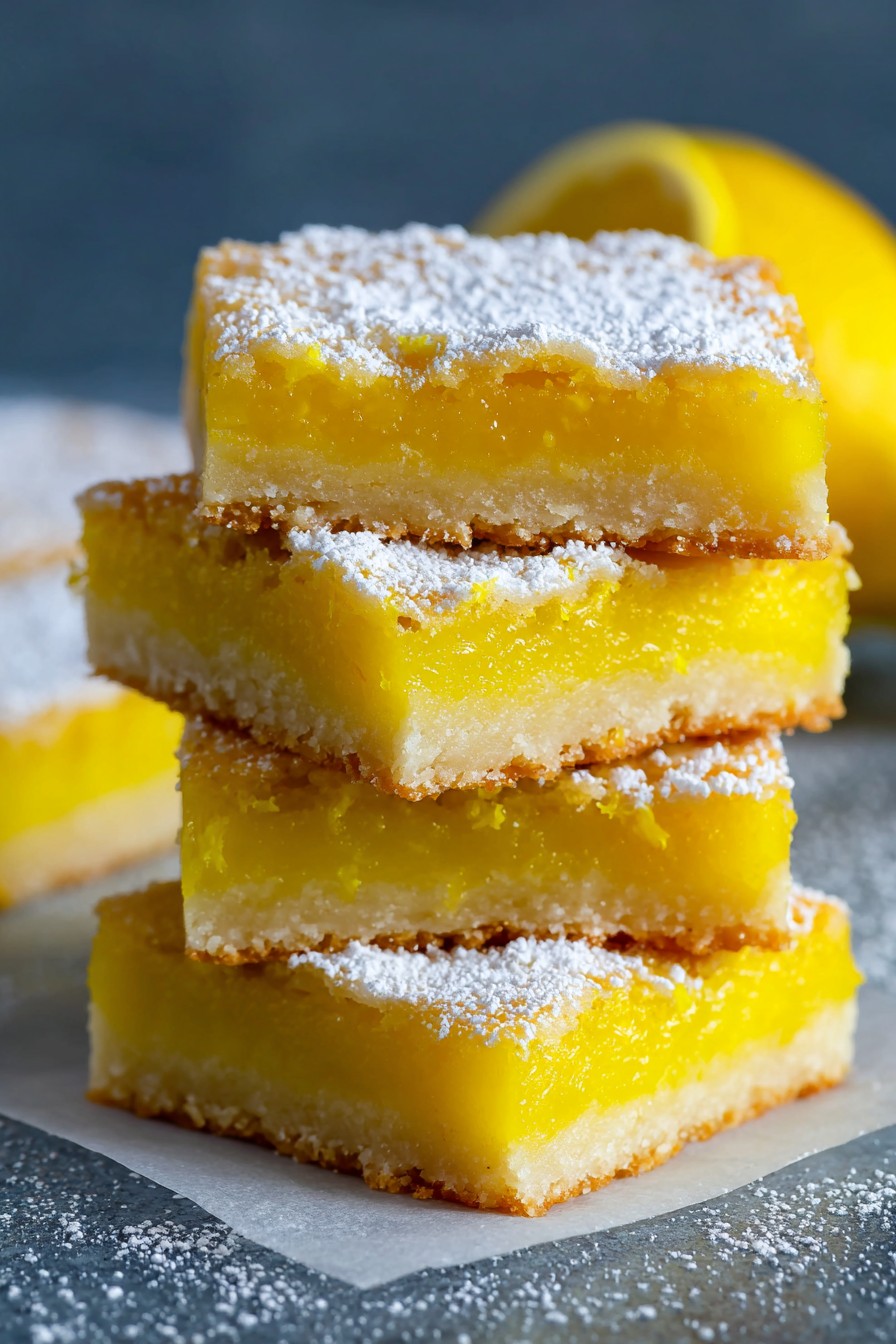
Kindred spirits, gather ’round. There’s a certain magic in the simple things, a warmth that settles in the kitchen when you’re baking from the heart. Today, I’m dusting off a well-loved, handwritten card from my grandmother’s recipe box to share her legendary lemon bars—a perfect balance of buttery shortbread and bright, puckery-sweet lemon filling that tastes like a sunbeam captured on a plate.
Why This Recipe Works
- A buttery, pre-baked shortbread crust provides a sturdy, flavorful foundation that won’t get soggy.
- Fresh lemon juice and zest deliver an authentic, vibrant citrus punch that bottled juice can’t match.
- The filling sets up beautifully with a creamy, custard-like texture, thanks to the precise balance of eggs, sugar, and flour.
- Dusting with powdered sugar just before serving adds a lovely sweetness and a classic, finished look.
Ingredients
- For the Crust: 1 cup (2 sticks) of unsalted butter, softened at room temperature; 1/2 cup of granulated sugar; 2 cups of all-purpose flour; 1/4 teaspoon of fine sea salt.
- For the Filling: 4 large eggs, at room temperature; 1 1/2 cups of granulated sugar; 1/2 cup of all-purpose flour; 2/3 cup of fresh lemon juice (from about 4-5 medium lemons); The zest from 2 of those lemons, finely grated; 1/4 teaspoon of fine sea salt.
- For Dusting: 1/4 cup of powdered sugar, for sifting over the top.
Equipment Needed
- 9×13-inch baking pan (metal or glass)
- Parchment paper
- Electric hand mixer or stand mixer
- Medium mixing bowl
- Whisk
- Zester or fine grater
- Juicer or reamer
- Fine-mesh sieve (for dusting sugar)
Instructions
Step 1: Preparing the Pan and Oven
First, let’s get our workspace ready. Preheat your oven to 350°F (175°C). This ensures it’s perfectly heated and steady by the time our crust is mixed. Take your 9×13-inch baking pan and line it with a sheet of parchment paper, letting the ends overhang the sides. This little trick is a lifesaver—it creates a sling so you can lift the entire baked lemon bar slab out of the pan later for clean, easy cutting. Lightly grease any exposed parts of the pan not covered by the paper with a dab of butter or a quick spray of cooking oil. Tip: If your parchment paper is being stubborn and won’t lie flat, you can crinkle it into a ball first, then smooth it out in the pan; it becomes much more pliable.
Step 2: Making the Buttery Shortbread Crust
In the bowl of your stand mixer fitted with the paddle attachment, or in a large bowl using a hand mixer, combine the 1 cup of softened unsalted butter and 1/2 cup of granulated sugar. Beat them together on medium speed for about 2 to 3 minutes, until the mixture is light, fluffy, and pale in color. You should see the sugar granules become less distinct. In a separate bowl, whisk together the 2 cups of all-purpose flour and 1/4 teaspoon of fine sea salt. With the mixer on low speed, gradually add the flour mixture to the butter and sugar. Mix just until the dough comes together and no dry streaks of flour remain; it will be soft and slightly crumbly. Press this dough evenly and firmly into the bottom of your prepared parchment-lined pan. I like to use the bottom of a flat measuring cup to really tamp it down into a solid, uniform layer. Tip: For an extra-flaky crust, you can chill the pressed dough in the pan for 15 minutes before baking.
Step 3: Baking the Crust to Golden Perfection
Place the pan with the pressed crust on the middle rack of your preheated 350°F (175°C) oven. Bake for 18 to 22 minutes. You’re looking for the edges to turn a light golden brown and the top surface to look dry and set. It shouldn’t be fully browned all over, just taking on a hint of color. The crust will continue to bake a bit when we add the filling. While the crust is baking, this is the perfect time to prepare your lemon filling. Remove the pan from the oven and place it on a wire rack. Leave the oven on at 350°F (175°C). The crust needs to cool for about 10-15 minutes before you add the filling; it should still be warm to the touch but not piping hot.
Step 4: Whisking Up the Sunny Lemon Filling
While the crust is cooling, let’s make the heart of this recipe. In a medium mixing bowl, whisk the 4 large room-temperature eggs until they are well blended and slightly frothy. To this, add the 1 1/2 cups of granulated sugar, 1/2 cup of all-purpose flour, 2/3 cup of fresh lemon juice, the finely grated zest from 2 lemons, and the 1/4 teaspoon of fine sea salt. Whisk vigorously for a good minute or two until the mixture is completely smooth, thick, and pale yellow. You should see no lumps of flour or streaks of egg white. The zest will speckle the mixture beautifully. Tip: For the absolute brightest flavor, zest your lemons before you juice them—it’s much easier! Pour this sunny filling directly onto the warm, par-baked crust, using a spatula to spread it evenly to all corners.
Step 5: The Final Bake and Cooling Ritual
Carefully return the pan to the 350°F (175°C) oven. Bake for 20 to 25 minutes. The filling is done when the edges are set and the center shows just the slightest jiggle when you gently shake the pan. The top should be matte and set, not wet or shiny. Over-baking can cause the filling to crack. Once baked, transfer the pan back to the wire rack and let the lemon bars cool completely in the pan. This is non-negotiable for a clean slice—it will take about 2 hours at room temperature. Once completely cool, you can use the parchment paper sling to lift the entire slab onto a cutting board. For the cleanest cuts, I recommend chilling the slab in the refrigerator, uncovered, for at least 1 hour before slicing. Just before serving, use a fine-mesh sieve to dust the top generously with the 1/4 cup of powdered sugar. Cut into squares or rectangles, wiping your knife clean between cuts for pristine edges.
Tips and Tricks
For the most tender crust, make sure your butter is truly softened—it should yield easily to a gentle press but not be greasy or melted. If you’re in a pinch, you can cube cold butter and beat it with the sugar for a longer time; it will eventually incorporate. When zesting your lemons, avoid the bitter white pith beneath the yellow skin. A microplane grater is the perfect tool for this. If your powdered sugar tends to melt or disappear into the filling after dusting, try dusting it twice: once right after cutting, then a second, lighter dusting just before serving for that perfect snowy finish. For storage, keep the bars in an airtight container in the refrigerator for up to 5 days. They can also be frozen for up to 3 months; freeze the whole uncut slab or individual bars on a parchment-lined tray before transferring to a freezer bag. Thaw in the fridge overnight.
Recipe Variations
- Lavender Lemon Bars: Add 1 teaspoon of culinary-grade dried lavender buds to the granulated sugar for the filling. Let it sit for an hour to infuse before whisking with the other ingredients for a beautifully floral note.
- Ginger-Spiced Crust: Add 1 teaspoon of ground ginger and 1/4 teaspoon of freshly grated nutmeg to the flour when making the shortbread crust for a warm, spiced base.
- Berry Swirl: Before baking the filling, dollop 1/4 cup of seedless raspberry or blackberry jam in several spots over the lemon filling. Use a toothpick or knife to gently swirl it for a marbled, fruity effect.
- Coconut Lime Bars: Substitute lime juice and zest for the lemon. After dusting with powdered sugar, sprinkle the top with 1/2 cup of toasted sweetened coconut flakes for a tropical twist.
- Almond Shortbread Crust: Replace 1/2 cup of the all-purpose flour in the crust with 1/2 cup of finely ground almond flour for a nuttier, more tender base.
Frequently Asked Questions
Q: Can I use bottled lemon juice instead of fresh?
A: I highly recommend fresh lemons. Bottled juice often has preservatives and lacks the vibrant, bright flavor and aromatic oils from the zest that make these bars special. For the best taste, fresh is non-negotiable.
Q: My filling cracked on top after baking. What did I do wrong?
A: Cracking usually means the bars were slightly over-baked. Remember, the center should have a slight jiggle when you take it out. It will set fully as it cools. Also, ensure your oven temperature is accurate with an oven thermometer.
Q: How do I get really clean, sharp cuts on my lemon bars?
A: The key is chilling. Let the bars cool completely, then refrigerate the whole slab for at least an hour. Use a sharp chef’s knife, wiping it clean with a damp cloth between each cut. This prevents the filling from smearing.
Q: Can I make these gluten-free?
A: Absolutely. Use a 1:1 gluten-free all-purpose flour blend for both the crust and the filling. The results are excellent, with no other changes needed to the recipe.
Q: Why do my lemon bars have a foamy layer on top?
A: This happens if the filling is over-whisked, incorporating too much air. Whisk just until the ingredients are smooth and combined—you don’t need to beat it like you’re making a meringue.
Summary
These lemon bars, with their buttery shortbread and sun-bright filling, are more than a dessert—they’re a taste of home, a simple joy to bake and share with those you love.
Grandma's Perfect Lemon Bars
24
servings25
minutes45
minutesIngredients
Instructions
- 1 Preheat oven to 350°F (175°C). Line a 9x13-inch pan with parchment paper, leaving an overhang on two sides. Lightly grease exposed pan.
- 2 Beat butter and 1/2 cup sugar until light and fluffy. Whisk 2 cups flour with 1/4 tsp salt, then mix into butter on low until combined. Press dough firmly into prepared pan.
- 3 Bake crust for 18-22 minutes until edges are light golden. Cool on rack for 10-15 minutes (keep oven on).
- 4 Whisk eggs until blended. Add 1 1/2 cups sugar, 1/2 cup flour, lemon juice, zest, and 1/4 tsp salt. Whisk until completely smooth.
- 5 Pour filling over warm crust. Bake for 20-25 minutes until edges are set and center jiggles slightly. Cool completely in pan (about 2 hrs). Chill for 1 hour, then lift out using parchment. Dust with powdered sugar, cut, and serve.