Widely regarded as the gold standard of cheesecakes, the New York style distinguishes itself through an uncompromisingly rich, dense, and velvety texture. While seemingly simple, achieving that perfect, crack-free surface and creamy interior requires precise technique and patience. This recipe deconstructs the classic, guiding you through each critical stage to produce a bakery-worthy dessert that is both luxurious in flavor and structurally impeccable.
Why This Recipe Works
- Full-Fat Foundation: Using only full-fat cream cheese and sour cream ensures a rich, non-grainy texture and prevents weeping.
- Water Bath Mastery: Baking the cheesecake in a water bath provides gentle, even heat to prevent cracks and overcooked edges.
- Gradual Temperature Control: A slow oven cool-down and extended chilling period allow the custard to set perfectly without internal stress fractures.
- Acidic Balance: A precise amount of fresh lemon juice and vanilla extract cuts through the richness, enhancing the overall flavor profile without overpowering it.
Ingredients
- For the Graham Cracker Crust: 2 cups (about 200g) finely ground graham cracker crumbs, 1/2 cup (1 stick / 113g) unsalted butter (melted and cooled slightly), 1/4 cup (50g) granulated sugar, 1/8 teaspoon fine sea salt.
- For the Cheesecake Filling: 32 ounces (four 8-oz packages / 907g total) full-fat cream cheese (softened to room temperature), 1 1/2 cups (300g) granulated sugar, 1/4 teaspoon fine sea salt, 1 teaspoon pure vanilla extract, 2 teaspoons fresh lemon juice, 4 large eggs (at room temperature), 2/3 cup (160ml) full-fat sour cream (at room temperature), 2/3 cup (160ml) heavy cream.
Equipment Needed
- 9-inch or 10-inch springform pan
- Stand mixer with paddle attachment or electric hand mixer
- Large roasting pan (for water bath)
- Heavy-duty aluminum foil
- Fine-mesh sieve
- Rubber spatula
- Instant-read thermometer (recommended)
Instructions
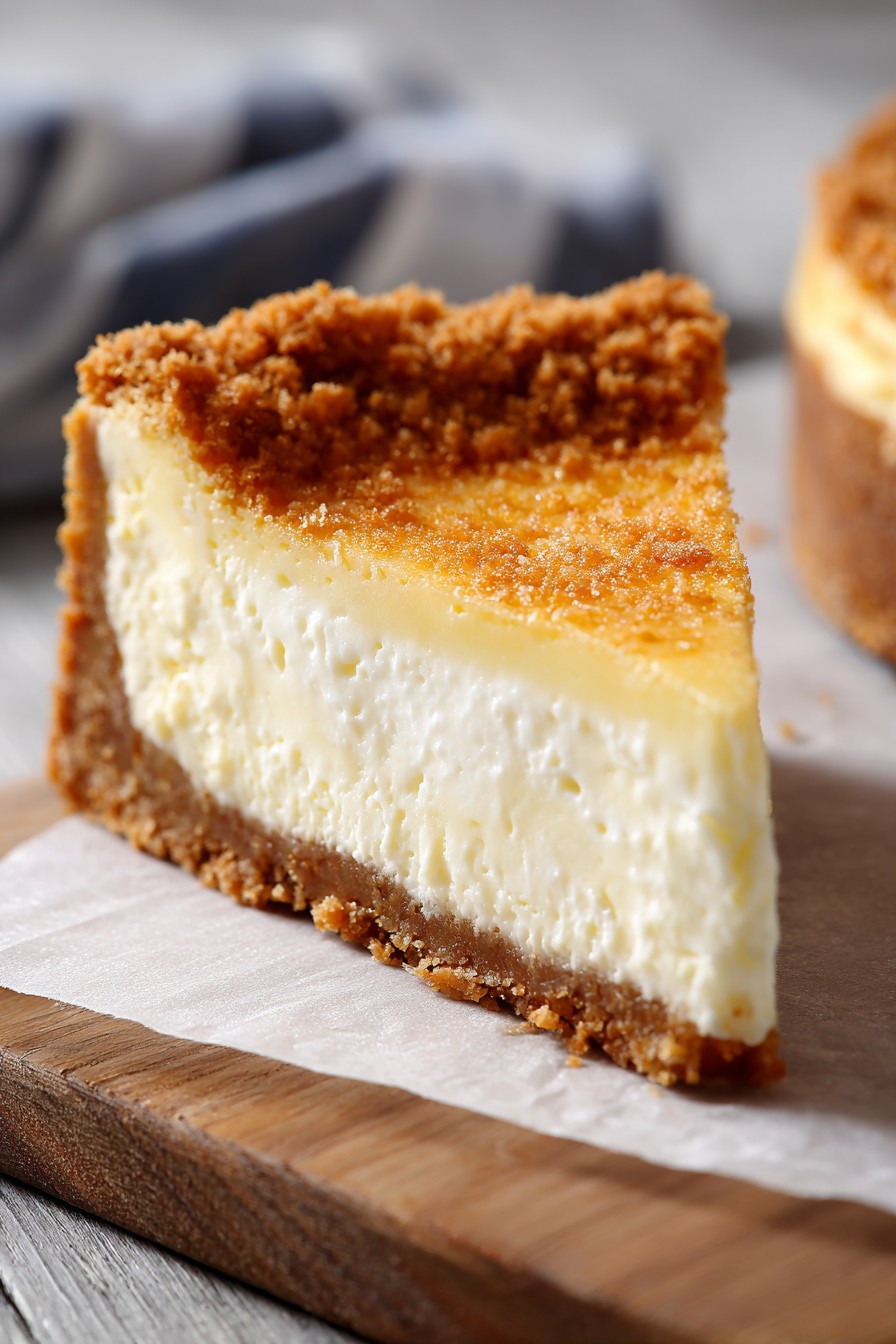
Step 1: Prepare the Pan and Construct the Crust
Begin by positioning your oven rack to the lower-middle position and preheating to 350°F (175°C). Thoroughly wrap the outside bottom and sides of your 9-inch springform pan with a double layer of 18-inch heavy-duty aluminum foil; this is a non-negotiable step to prevent water seepage during the bath. In a medium bowl, combine the 2 cups of graham cracker crumbs, 1/4 cup granulated sugar, and 1/8 teaspoon salt. Drizzle the 1/2 cup of melted, cooled butter over the crumb mixture. Using a fork, mix until the crumbs are uniformly moistened and resemble wet sand. Transfer the mixture into the prepared springform pan. Using the bottom of a measuring cup or glass, press the crumbs firmly and evenly across the bottom and about 1 1/2 inches up the sides. Bake the crust on the lower-middle rack for 10 minutes, until it is fragrant and lightly set. Remove and place on a wire rack to cool completely before adding the filling. Pro Tip: For the cleanest slice, line the bottom of the springform pan with a parchment round before adding the crust mixture; this allows for easy removal after chilling.
Step 2: Mix the Cream Cheese Base to Perfection
Ensure all your filling ingredients—especially the 32 ounces of cream cheese, 2/3 cup sour cream, and 4 large eggs—are at true room temperature (about 70°F) for at least 2 hours. Cold ingredients will cause overmixing and incorporate excess air, leading to a cracked surface. In the bowl of a stand mixer fitted with the paddle attachment, combine the softened cream cheese, 1 1/2 cups granulated sugar, and 1/4 teaspoon salt. Mix on low speed for 1 minute just to combine, then scrape down the bowl and beater thoroughly. Increase speed to medium-low and beat for exactly 3 minutes, until the mixture is completely smooth, glossy, and free of any lumps. Scrape the bowl and paddle again. With the mixer on low, add the 1 teaspoon vanilla extract and 2 teaspoons lemon juice, mixing until just incorporated.
Step 3: Incorporate Eggs and Dairy with Deliberate Care
With the mixer still on its lowest setting, add the 4 room-temperature eggs one at a time, allowing each egg to be fully absorbed into the batter—about 30 seconds of mixing—before adding the next. After the final egg is incorporated, stop the mixer and scrape the bowl thoroughly. This gradual addition prevents over-aeration. In a separate bowl or large liquid measuring cup, whisk together the 2/3 cup room-temperature sour cream and 2/3 cup heavy cream until homogenous. With the mixer on low, slowly pour this cream mixture into the cheesecake batter. Mix for no more than 30 seconds, just until the batter is smooth and uniform. It should be thick, creamy, and pourable. Pro Tip: For the silkiest possible texture, pass the finished batter through a fine-mesh sieve into a clean bowl to remove any remaining tiny lumps of cream cheese.
Step 4: Bake Using the Controlled Water Bath Method
Place the springform pan with the cooled crust inside the large roasting pan. Pour the strained cheesecake batter into the crust, gently tapping the pan on the counter 3-4 times to release any large air bubbles. Bring a kettle of water to a boil. Carefully transfer the roasting pan to the preheated oven’s lower-middle rack. THEN, pour the boiling water into the roasting pan until it reaches halfway up the sides of the springform pan, about 1 to 1 1/2 inches deep. Bake at 350°F for 60 to 70 minutes. The cheesecake is done when the edges are set and puffed about 1 inch in from the edge, but the center—a circle about 4-5 inches across—still jiggles coherently like Jell-O when the pan is gently shaken. An instant-read thermometer inserted 1 inch from the edge should read 165°F to 170°F.
Step 5: Execute the Critical Cooling and Chilling Phase
Turn off the oven and crack the oven door open about 1 inch using a wooden spoon. Allow the cheesecake to cool slowly in the water bath inside the oven for 1 hour. This gradual temperature drop is the primary defense against surface cracking. After 1 hour, carefully remove the entire roasting pan from the oven. Lift the springform pan out of the water bath, peel away the foil, and place it on a wire rack. Run a thin, sharp paring knife around the very edge of the cheesecake to separate it from the pan—this prevents it from pulling and cracking as it contracts during cooling. Let it cool to room temperature on the rack, which will take about 2 more hours. Once completely cool, loosely cover the top of the pan with plastic wrap or foil and refrigerate for a minimum of 8 hours, preferably 24 hours, to allow the custard to fully set and the flavors to mature. Pro Tip: For pristine serving, dip a sharp, thin-bladed knife in hot water and wipe it dry between each slice.
Tips and Tricks
For a super-smooth top, after straining the batter, use a kitchen torch to quickly pass over the surface and pop any remaining tiny bubbles before baking. If you lack a roasting pan large enough, place the foil-wrapped springform pan inside a high-sided baking sheet and place this on the oven rack; pour boiling water into the baking sheet, then carefully slide the rack into the oven. To test for true room temperature cream cheese, press it with a finger; it should yield easily without feeling cold. If you see small surface cracks forming during the final bake, don’t panic—they often close up during the slow cool. For the ultimate clean release, after the full chill, briefly pass a blow dryer on low heat around the outside of the springform pan to slightly warm the metal before unclasping it.
Recipe Variations
- Chocolate Marble: Remove 1 cup of plain batter after mixing. Melt 4 ounces of finely chopped bittersweet chocolate with 2 tablespoons of heavy cream, cool slightly, then fold into the reserved cup of batter. Dollop over the plain batter in the pan and swirl with a knife.
- Citrus-Infused: Replace the lemon juice with 1 tablespoon of finely grated orange or lemon zest and 2 tablespoons of the corresponding citrus liqueur (like Grand Marnier or Limoncello) for a bright, aromatic twist.
- Dulce de Leche Swirl: Warm 3/4 cup of store-bought or homemade dulce de leche until pourable. After pouring the batter into the crust, dollop the dulce de leche on top and swirl gently with a knife for a rich caramel flavor.
- Cookie Crust Alternative: Substitute the graham crackers with an equal weight of finely crushed vanilla wafers, chocolate sandwich cookies (with filling removed), or speculoos cookies for a different flavor foundation.
Frequently Asked Questions
Q: Can I use light or Neufchâtel cream cheese?
A: No. Full-fat cream cheese is essential. Lower-fat versions contain more water and stabilizers, resulting in a weaker structure, potential weeping, and a less creamy, more grainy texture. The high fat content is what creates the signature dense, rich mouthfeel.
Q: My cheesecake cracked. What went wrong?
A: Cracking is typically caused by one of three issues: overmixing the batter (incorporating too much air), a rapid temperature change (skipping the slow oven cool-down), or overbaking. Ensure all ingredients are at room temperature, mix on low speed, use the water bath, and follow the slow cooling protocol precisely.
Q: How do I know it’s done baking if the center is still jiggly?
A: The jiggle test is correct. The center should jiggle as a unified mass, not appear liquid or sloshy. The residual heat will continue to cook the center during the hour-long cool in the oven. An instant-read thermometer reading of 165-170°F at the edge confirms it’s safe.
Q: Can I freeze a baked cheesecake?
A: Yes, after it has fully chilled and set. Wrap the entire chilled cheesecake (or individual slices) tightly in plastic wrap, then in aluminum foil. Freeze for up to 2 months. Thaw overnight in the refrigerator before serving.
Q: Why is such a long chilling time necessary?
A> The chilling period is a final, crucial set. It allows the proteins and fats in the custard to fully firm up, transforming the texture from soft to luxuriously dense and sliceable. It also allows the flavors to meld and deepen significantly.
Summary
This New York-style cheesecake achieves its iconic density and creamy texture through precise technique: room-temperature ingredients, minimal air incorporation, a protective water bath, and mandatory slow cooling and extended chilling.
New York Style Cheesecake
12
servings30
minutes70
minutesIngredients
Instructions
- 1 Preheat oven to 350°F. Wrap springform pan in foil. Mix crumbs, 1/4 cup sugar, salt with melted butter. Press into pan. Bake 10 min. Cool.
- 2 Beat cream cheese, 1 1/2 cups sugar, salt on medium-low until smooth (3 min). Mix in vanilla and lemon juice on low.
- 3 On low, add eggs one at a time. Whisk sour cream and heavy cream; mix into batter on low until just combined. Strain batter.
- 4 Place pan in roasting pan. Pour batter into crust. Place in oven. Pour boiling water into roasting pan to 1-inch depth. Bake 60-70 min until edges are set and center jiggles.
- 5 Turn off oven, crack door, cool in oven 1 hr. Remove, run knife around edge, cool to room temp (2 hrs). Refrigerate 8-24 hours.