Heralded as the quintessential centerpiece for effortless entertaining, this slow cooker pulled pork recipe transforms a humble pork shoulder into succulent, fall-apart perfection. Harnessing the gentle, prolonged heat of a slow cooker, this method guarantees deeply developed flavors and unparalleled tenderness without the need for constant monitoring or specialized smoking equipment.
Why This Recipe Works
- Low-and-Slow Cooking: The extended 8-10 hour cook time at 275°F allows tough collagen in the pork shoulder to fully render into gelatin, ensuring exceptionally moist and tender meat.
- Strategic Fat Cap Placement: Positioning the pork fat-side up enables the rendered fat to baste the meat continuously throughout the cooking process, preventing dryness.
- Layered Flavor Development: A dry rub applied 12-24 hours in advance penetrates deeply, while a braising liquid of apple cider vinegar and chicken stock creates a flavorful steam environment and forms the base for a finishing sauce.
- Dual-Phase Texture Management: An initial high-heat sear creates a flavorful crust (Maillard reaction), while the slow cooker phase is dedicated solely to achieving perfect internal tenderness.
Ingredients
- 1 (5-6 pound) bone-in pork shoulder (Boston butt), fat cap trimmed to 1/4-inch thickness
- 3 tablespoons packed dark brown sugar
- 2 tablespoons smoked paprika
- 1 tablespoon kosher salt
- 2 teaspoons garlic powder
- 2 teaspoons onion powder
- 1 teaspoon ground black pepper
- 1/2 teaspoon cayenne pepper (optional)
- 1 cup low-sodium chicken stock
- 1/2 cup apple cider vinegar
- 2 tablespoons Worcestershire sauce
- 1 large yellow onion, thinly sliced
- 4 cloves garlic, smashed
- 2 bay leaves
Equipment Needed
- 6- to 8-quart slow cooker
- Large cast-iron skillet or heavy-bottomed sauté pan
- Instant-read thermometer
- Tongs
- Two forks or meat claws for pulling
- Fine-mesh strainer
- Fat separator or measuring cup
- Rimmed baking sheet
Instructions
Step 1: Prepare and Season the Pork
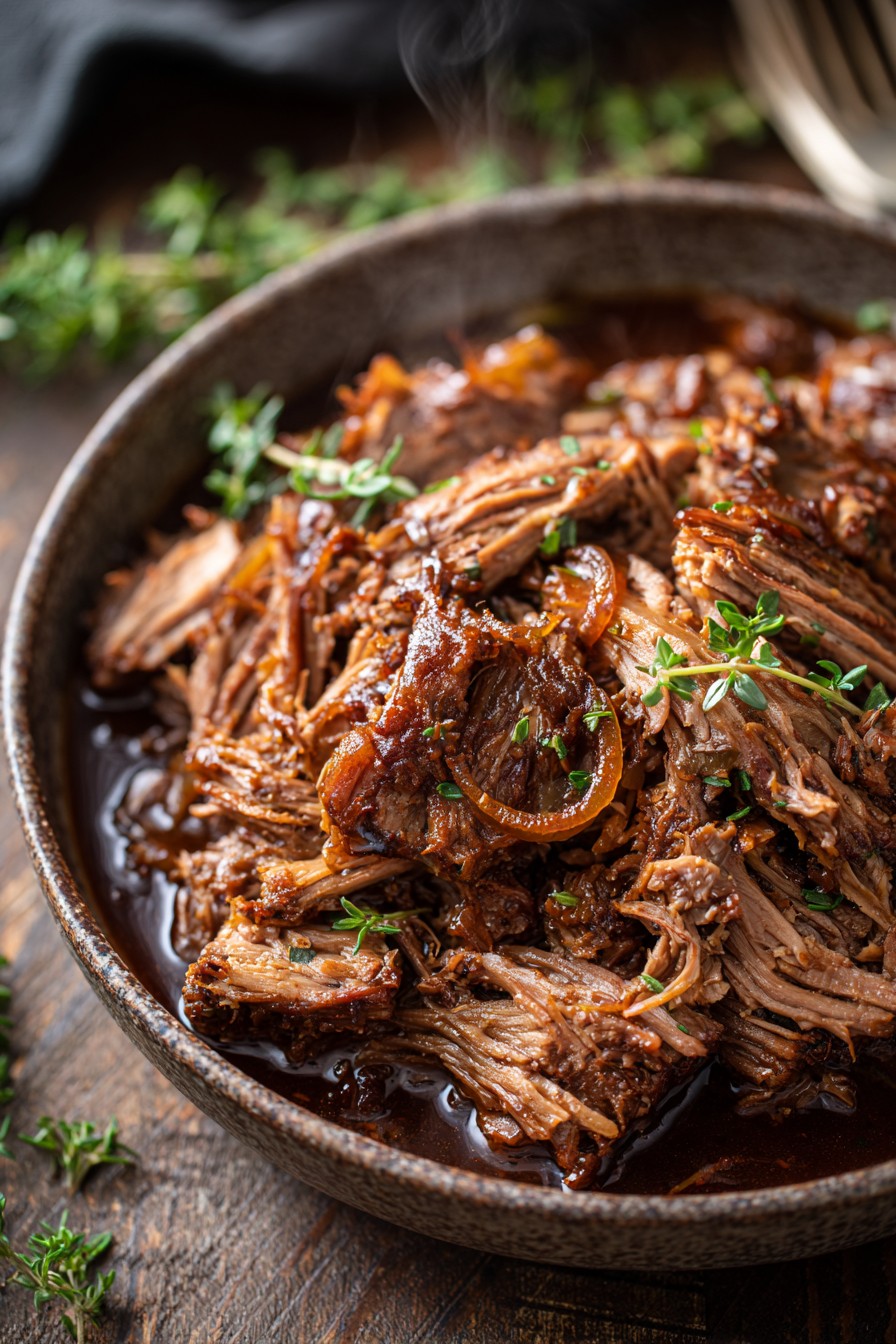
Begin by patting the 5-6 pound bone-in pork shoulder completely dry with paper towels; this is critical for optimal spice adhesion and effective searing. In a small bowl, combine 3 tablespoons of dark brown sugar, 2 tablespoons of smoked paprika, 1 tablespoon of kosher salt, 2 teaspoons each of garlic powder and onion powder, 1 teaspoon of black pepper, and the optional 1/2 teaspoon of cayenne. Whisk thoroughly to eliminate any clumps. Apply this dry rub mixture liberally and uniformly over the entire surface of the pork, including the sides, ensuring every crevice is coated. For maximum flavor penetration, place the seasoned pork on a wire rack set over a rimmed baking sheet and refrigerate, uncovered, for a minimum of 12 hours and up to 24 hours. This dry-brining period allows the salt to season the meat deeply and helps the surface dry further, which will promote a superior sear. Tip: For an even more robust bark, consider adding 1 teaspoon of ground coffee or cocoa powder to your dry rub blend.
Step 2: Sear the Pork to Develop Flavor
Remove the pork from the refrigerator and let it stand at room temperature for 45-60 minutes to temper. Preheat a large cast-iron skillet over medium-high heat for 3-4 minutes until it is visibly hot. Add 1 tablespoon of a neutral, high-smoke-point oil (such as grapeseed or avocado oil) and swirl to coat. Carefully place the pork shoulder into the skillet, fat-side down first. Sear undisturbed for 4-5 minutes, or until a deep golden-brown crust forms. Using sturdy tongs, rotate the pork to sear each remaining side for 3-4 minutes per side, aiming for an even, caramelized exterior on all surfaces. This Maillard reaction is non-negotiable for building complex, savory flavor foundations that the slow cooker alone cannot replicate. Once seared, transfer the pork to a clean plate.
Step 3: Build the Braising Liquid and Assemble
While the skillet is still hot, pour in 1 cup of low-sodium chicken stock to deglaze, using a wooden spoon to scrape up all the flavorful browned bits (fond) from the bottom of the pan. Allow the stock to simmer for 1 minute, then remove from heat. In your 6- to 8-quart slow cooker insert, create a flavor bed by scattering 1 thinly sliced large yellow onion and 4 smashed garlic cloves evenly across the bottom. Place the 2 bay leaves on top of this vegetable layer. Position the seared pork shoulder fat-side up on this aromatic base. Pour the deglazed stock from the skillet over the pork, followed by 1/2 cup of apple cider vinegar and 2 tablespoons of Worcestershire sauce. The liquid should come approximately one-third of the way up the side of the pork; it is not meant to submerge it.
Step 4: Execute the Low-and-Slow Cook
Secure the lid on the slow cooker. Set the appliance to the LOW setting and cook for 8 to 10 hours. The exact time will depend on the specific shape and density of your pork shoulder. The pork is done when it reaches an internal temperature of 195°F to 203°F, as measured by an instant-read thermometer inserted into the thickest part of the meat, avoiding the bone. At this temperature range, the collagen has fully hydrolyzed into gelatin, and the meat will offer no resistance when probed. Tip: Resist the urge to open the lid during cooking, as this releases a significant amount of heat and steam, potentially adding 30-45 minutes to your total cook time.
Step 5: Rest, Pull, and Sauce the Pork
Once the target internal temperature is achieved, carefully transfer the pork shoulder to a large cutting board or baking sheet, tent loosely with aluminum foil, and allow it to rest for 45 minutes to 1 hour. This resting period is essential for the juices to redistribute throughout the meat. Meanwhile, strain the cooking liquid from the slow cooker through a fine-mesh strainer into a fat separator or a large measuring cup. Discard the solids. Skim and discard the fat from the surface of the liquid. Transfer the defatted braising liquid to a small saucepan and simmer over medium heat until reduced by half, about 10-15 minutes, to create a concentrated finishing sauce. Using two forks or meat claws, shred the rested pork into bite-sized pieces, discarding any large pieces of fat or connective tissue. Toss the pulled pork with the reduced finishing sauce to taste, ensuring it is moist but not soggy. Tip: For extra-crispy edges, spread the sauced pulled pork in a single layer on a parchment-lined baking sheet and broil for 2-4 minutes, watching closely to prevent burning.
Tips and Tricks
For a more pronounced smoky flavor without a smoker, add 1-2 teaspoons of liquid smoke to the braising liquid, or include a smoked ham hock or turkey wing in the slow cooker with the pork. If your schedule requires a shorter cook time, you may use the HIGH setting for 5-6 hours, but monitor the internal temperature closely after the 5-hour mark, as the texture will be slightly less tender. The cooked and sauced pulled pork freezes exceptionally well. Portion it into airtight containers or freezer bags, removing as much air as possible, and freeze for up to 3 months. Thaw overnight in the refrigerator before reheating gently in a covered saucepan with a splash of stock or water. For serving, lightly toast your buns (brioche or potato rolls are ideal) and consider a tangy, vinegar-based slaw as the perfect textural and flavor counterpoint to the rich pork.
Recipe Variations
- Carolina-Style Vinegar Sauce: Replace the chicken stock with additional apple cider vinegar and add 1 tablespoon of red pepper flakes to the braising liquid. After pulling, toss the pork with a sauce made from the reduced cooking liquid, 1/4 cup of yellow mustard, and 2 tablespoons of honey.
- Korean BBQ (Bossam) Twist: Modify the dry rub to include 2 tablespoons of gochugaru (Korean red pepper flakes) and 1 tablespoon of grated ginger. For the braising liquid, use 1 cup of low-sodium beef broth mixed with 1/2 cup of soy sauce and 1/4 cup of mirin. Serve with quick-pickled radishes and ssamjang for wrapping in lettuce leaves.
- Cuban-Inspired Mojo Pork: Omit the dry rub. For the braising liquid, combine 1 cup of fresh orange juice, 1/2 cup of fresh lime juice, 8 smashed garlic cloves, 1 tablespoon of dried oregano, and 2 teaspoons of ground cumin. Cook as directed. Perfect for Cuban sandwiches or served with black beans and rice.
- Apple Cider and Bourbon Glaze: Add 1 cup of unfiltered apple cider and 1/4 cup of bourbon to the standard braising liquid. After reducing the defatted liquid, whisk in 2 tablespoons of Dijon mustard and 1 tablespoon of butter off the heat for a glossy, complex glaze.
Frequently Asked Questions
Q: Can I use a boneless pork shoulder instead of bone-in?
A: Yes, a boneless roast of similar weight (5-6 pounds) will work. The cook time may be slightly shorter, so begin checking the internal temperature at the 7-hour mark. The bone does contribute flavor, so consider adding a few pork neck bones or a smoked ham hock to the braising liquid if using boneless.
Q: My pork seems tough even after 10 hours. What happened?
A: Toughness indicates the collagen has not yet fully broken down. This typically means the pork has not reached the optimal internal temperature range of 195°F to 203°F. Continue cooking on LOW, checking the temperature every 30-45 minutes, until it probes tender and reaches this range.
Q: Is it necessary to sear the pork before slow cooking?
A> While not strictly mandatory, searing is highly recommended. It creates a flavorful crust via the Maillard reaction, adds textural contrast, and develops fond in the pan that forms the base of your finishing sauce. Skipping this step will result in a blander, steamier-tasting final product.
Q: Can I make this recipe ahead of time?
A: Absolutely. This dish benefits from being made a day ahead. Prepare through Step 5, then store the sauced pulled pork in an airtight container in the refrigerator for up to 3 days. Reheat gently in a covered dish in a 300°F oven or on the stovetop with a splash of liquid.
Q: What’s the best way to store and reheat leftovers?
A: Store cooled pulled pork in an airtight container in the refrigerator for up to 4 days. To reheat, place the desired portion in a saucepan with a tablespoon or two of water, broth, or the reserved finishing sauce. Cover and warm over low heat, stirring occasionally, until heated through. Avoid microwaving, which can dry out the meat.
Summary
This technique-driven recipe delivers supremely tender, flavor-packed pulled pork through strategic searing, a layered dry rub, and a precise low-and-slow cook. The resulting versatile protein is perfect for sandwiches, tacos, or grain bowls.
Slow Cooker Pulled Pork
10
servings30
minutes8
hoursIngredients
Instructions
- 1 Pat pork dry. Combine brown sugar, paprika, salt, garlic powder, onion powder, black pepper, and cayenne. Rub all over pork. Refrigerate on a rack over a baking sheet, uncovered, for 12-24 hours.
- 2 Let pork temper for 45-60 mins. Heat oil in a large skillet over medium-high. Sear pork on all sides until deeply browned, 4-5 mins per side. Transfer to a plate.
- 3 Scatter onion and garlic in slow cooker. Add bay leaves. Place pork fat-side up on top. Deglaze searing skillet with chicken stock, scraping up fond. Pour stock, vinegar, and Worcestershire over pork.
- 4 Cover and cook on LOW for 8-10 hours, until pork reaches 195°F-203°F internally and is fork-tender.
- 5 Transfer pork to a board, tent with foil, rest 45-60 mins. Strain cooking liquid, defat, and reduce by half in a saucepan. Shred pork, discarding fat/bone. Toss with reduced sauce to taste.